Clustering Customer Data

Overview

Using unsupervised learning techniques to divide customers into meaningful groups.

Presented by:
Larry Vincent,
Professor of the Practice
Marketing
Presented to:
MKT 512
February 19, 2026

Why clustering?

  • Identify natural groupings among survey respondents based on shared patterns in their responses.
  • Reveal structure in your data that isn’t visible from summary statistics alone—who thinks alike, and how?
  • Help you move from “what does the average respondent think?” to “what do different types of respondents think?”
  • Strengthen your analysis by showing whether key attitudes, behaviors, or preferences vary meaningfully across groups.
  • Provide a foundation for richer storytelling—clusters give you characters, not just numbers.

Key ideas from the reading

  • Clustering is unsupervised. There is no dependent variable. You’re asking the algorithm to find natural groupings, not predict an outcome.
  • Choose what to cluster on carefully. Don’t dump everything in by default. Select the variables that represent the differences you care about.
  • Best practice is to standardize variables, particularly if they have significantly different dimensions. This is especially true for k-means, which is sensitive to outliers.
  • Clustering algorithms will always produce clusters, even if the data doesn’t contain real or logical groups.

Case example

Le Abode

  • Le Abode is a fictional blog and e-commerce brand known for vintage-inspired, limited-edition home furnishings that sell out.
  • Endorsed by influential figures; strong growth from consumers investing more in home environments.
  • The team is evaluating a unique customer priority program and wants to understand who is the best target audience.
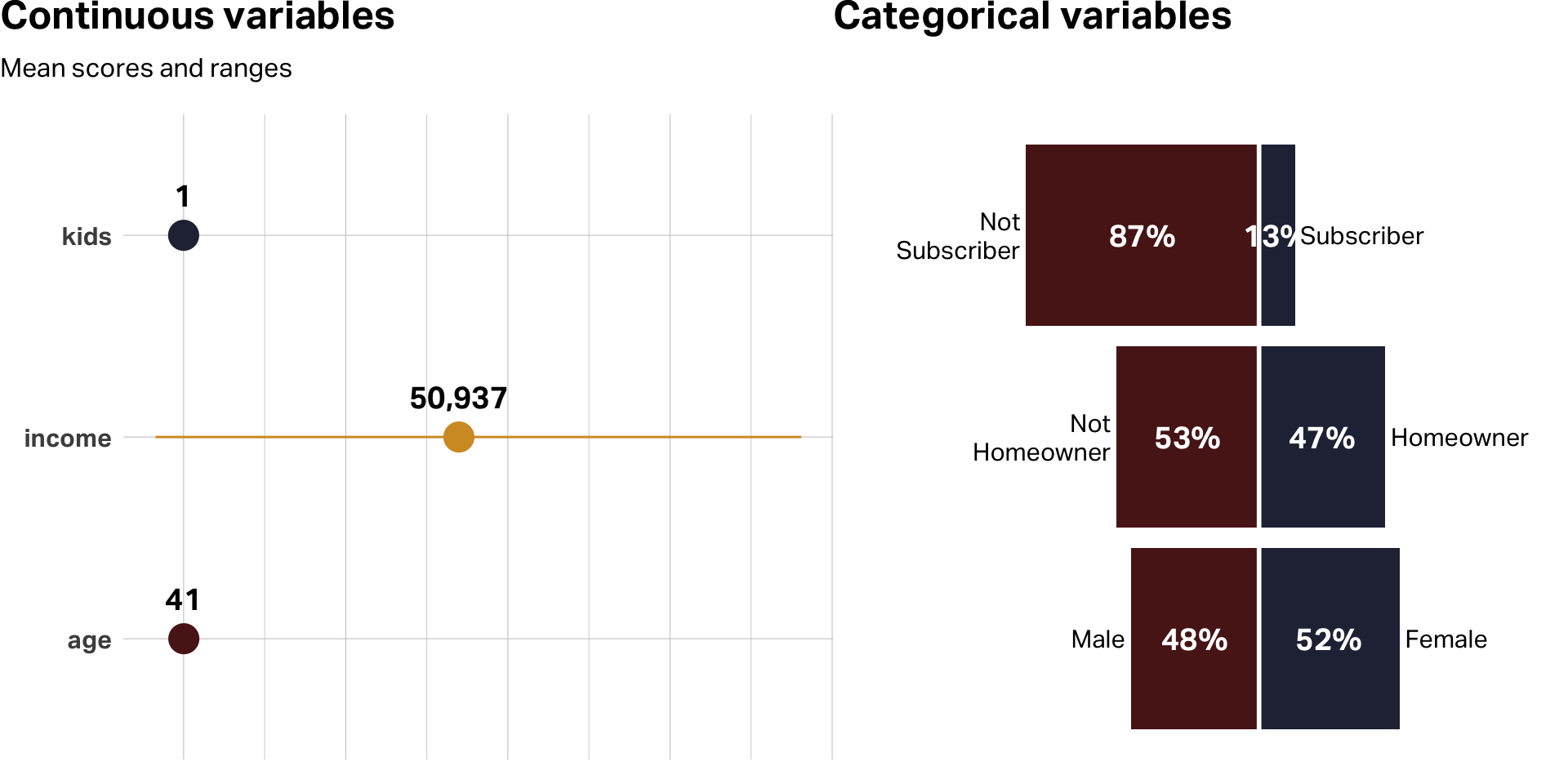
  • Dataset includes demographics such as age, income, home ownership, household size (kids), gender, and subscription to Le Abode’s priority reservation program.

Data inspection

Variable Median Mean SD Min Max NAs
age 39 41.2 12.7 19 80 0
female 1 0.5 0.5 0 1 0
income 52,014 50,936.5 20,137.5 −5,183 114,278 0
kids 1 1.3 1.4 0 7 0
own_home 0 0.5 0.5 0 1 0
subscribe 0 0.1 0.3 0 1 0

Analysis questions

  • Any consistent patterns? If so, what are they?
  • What are differences in segments in each model?
  • How actionable are the segmentation suggestions for each model? Could you target customers with these suggestions? Would they be useful in developing or improving marketing mix?

Considerations

  • Which data used for clustering?
  • Which clustering method?
  • How many clusters?
  • How to preprocess the data?
  • How to interpret the results?

K-Means

K-means clustering

  • Partitions data into k distinct clusters by assigning each data point to the cluster with the nearest centroid (mean).
  • Best suited when working with large datasets, numeric variables, and when the number of clusters (k) can be specified in advance.
  • Differentiated from other methods by its computational efficiency and simplicity, although it’s sensitive to outliers and initial centroid placement.
  • Requires standardizing variables; especially when they have varying dimensions. Multiple runs with different initializations recommended to ensure stability and consistency.
  • Requires a random seed for reproducibility.

Different data types
and scales

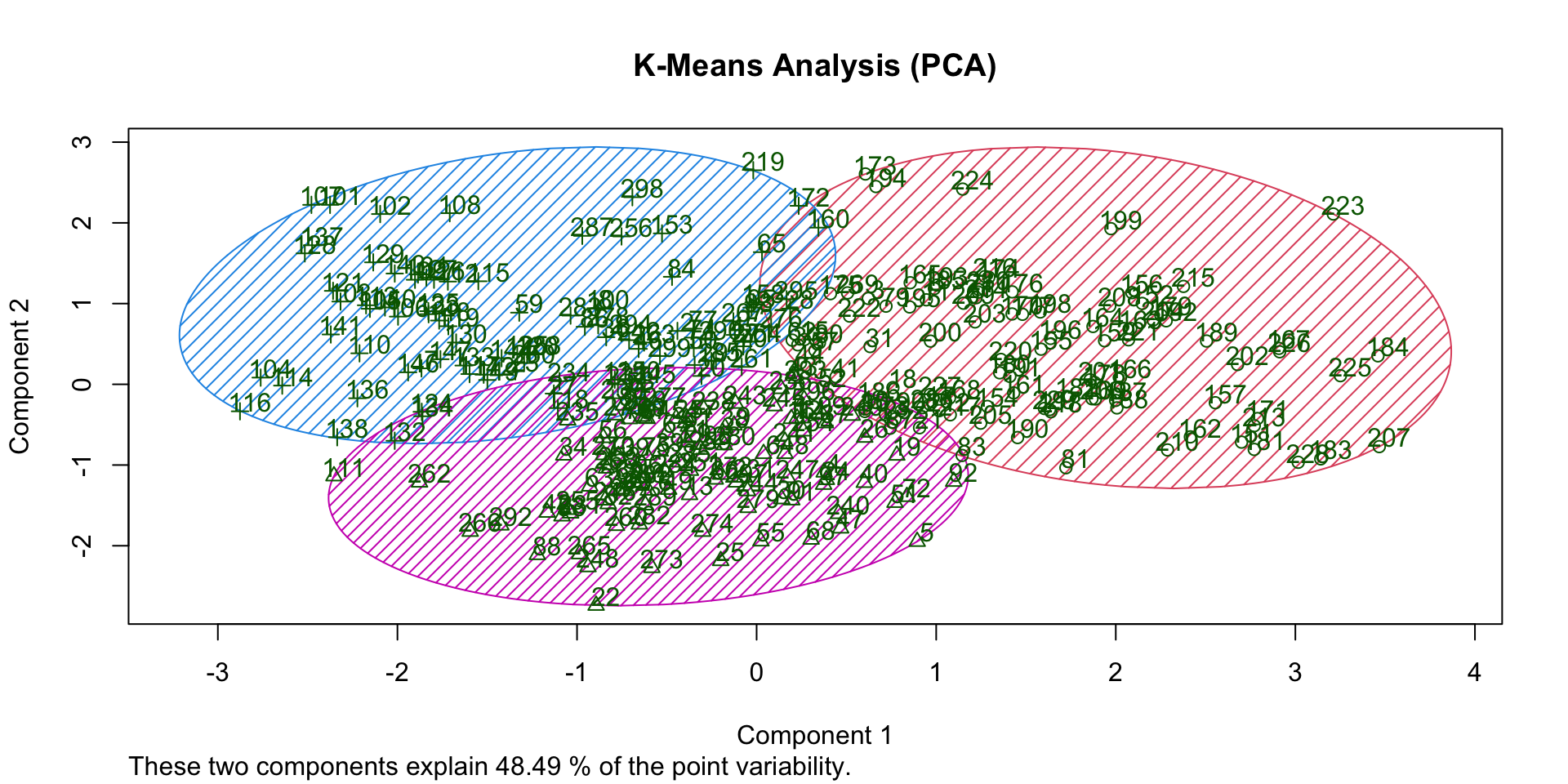
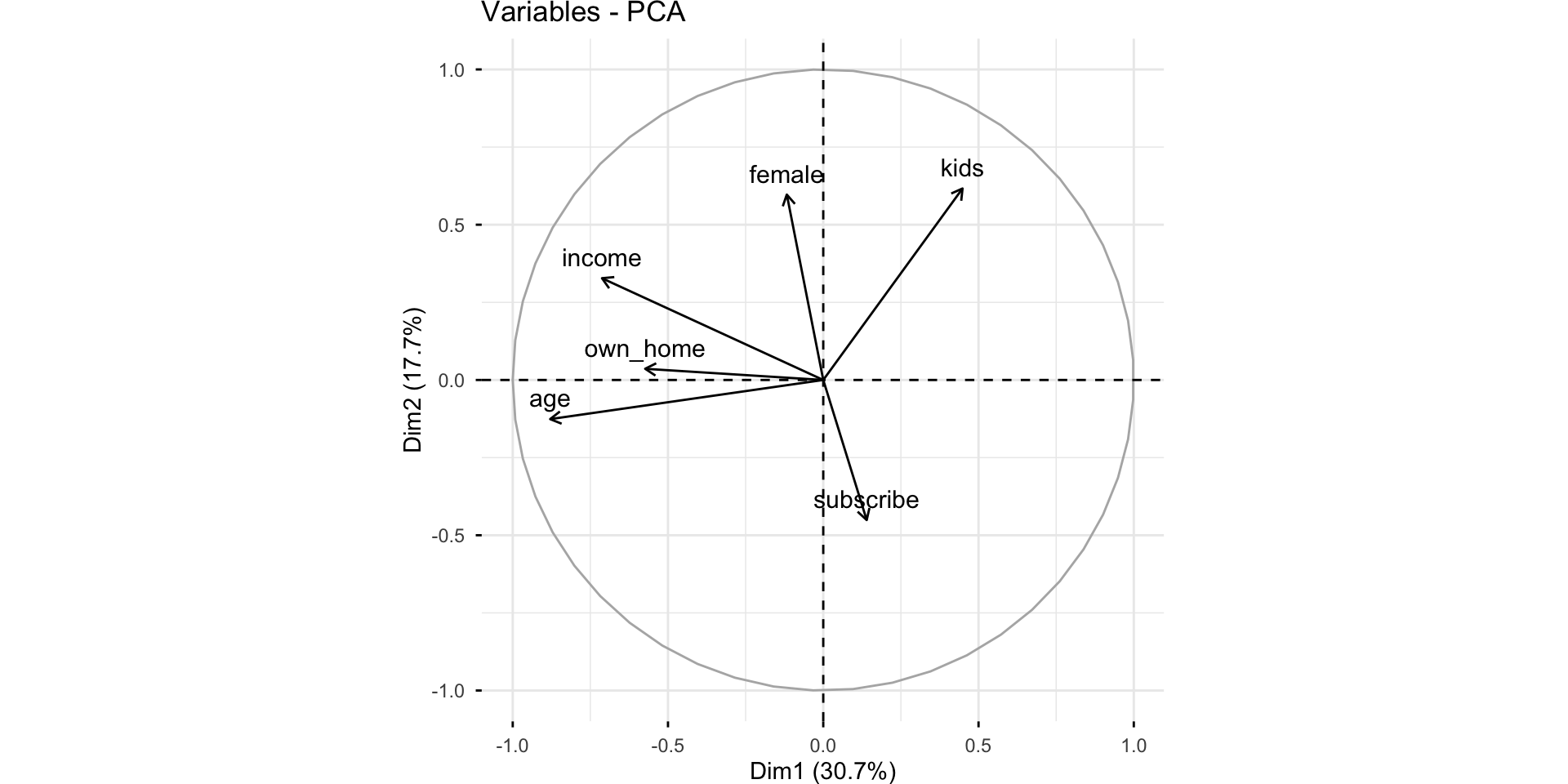
Pre-Processing with PCA
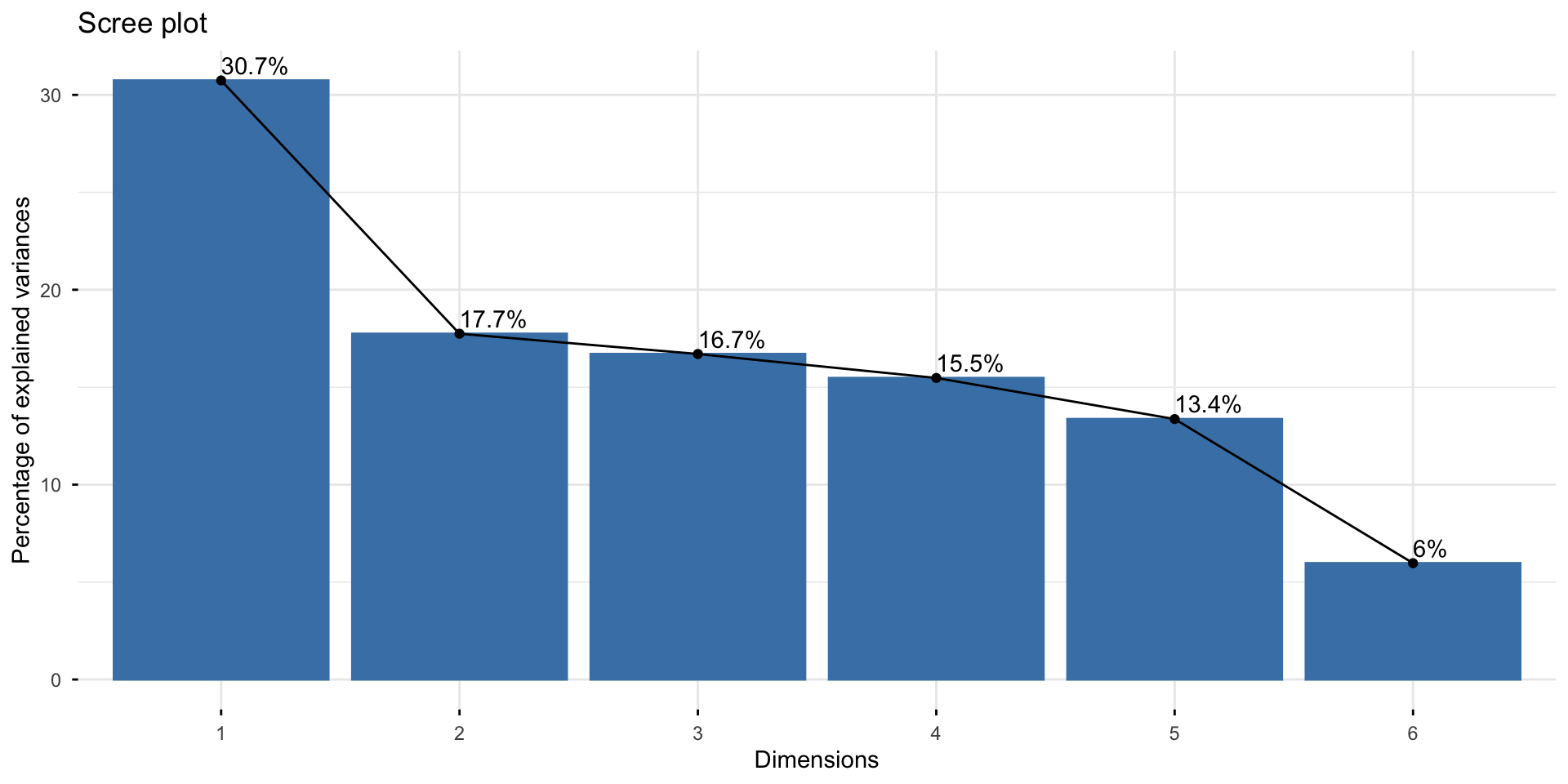
PCA
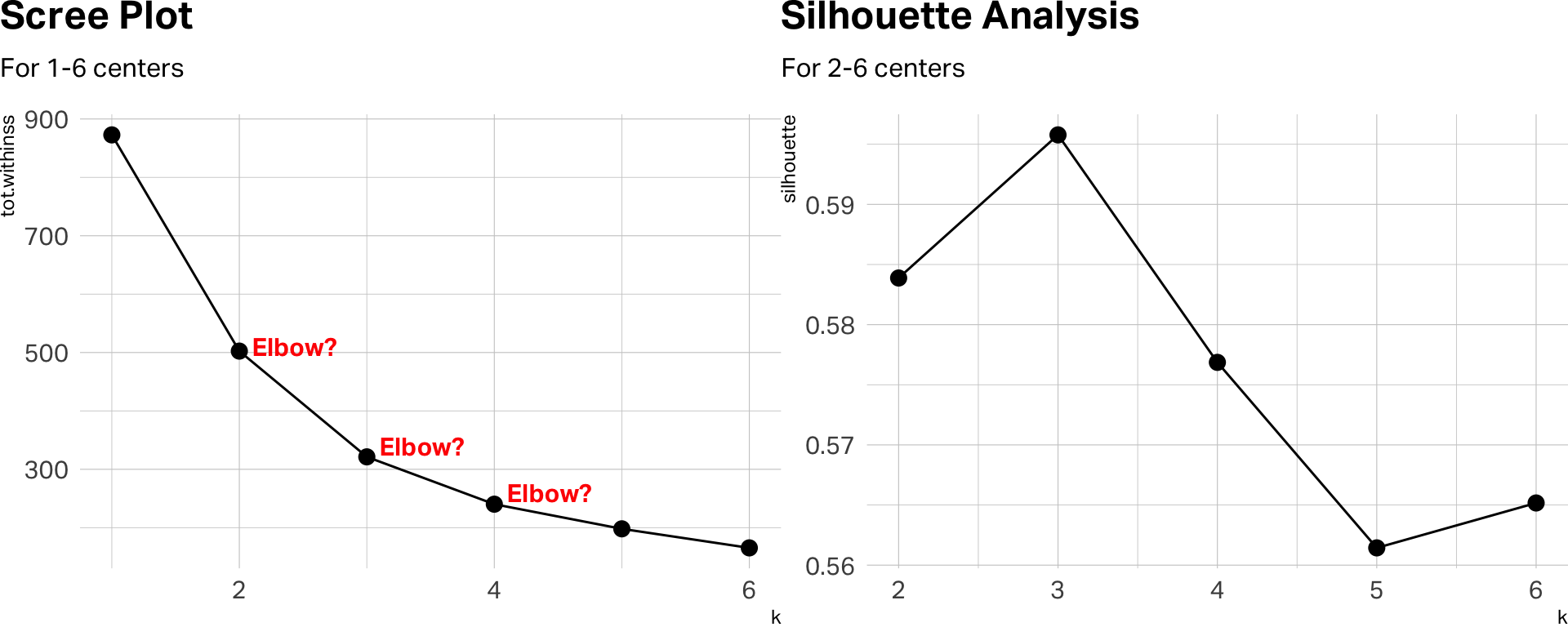
How many centers?
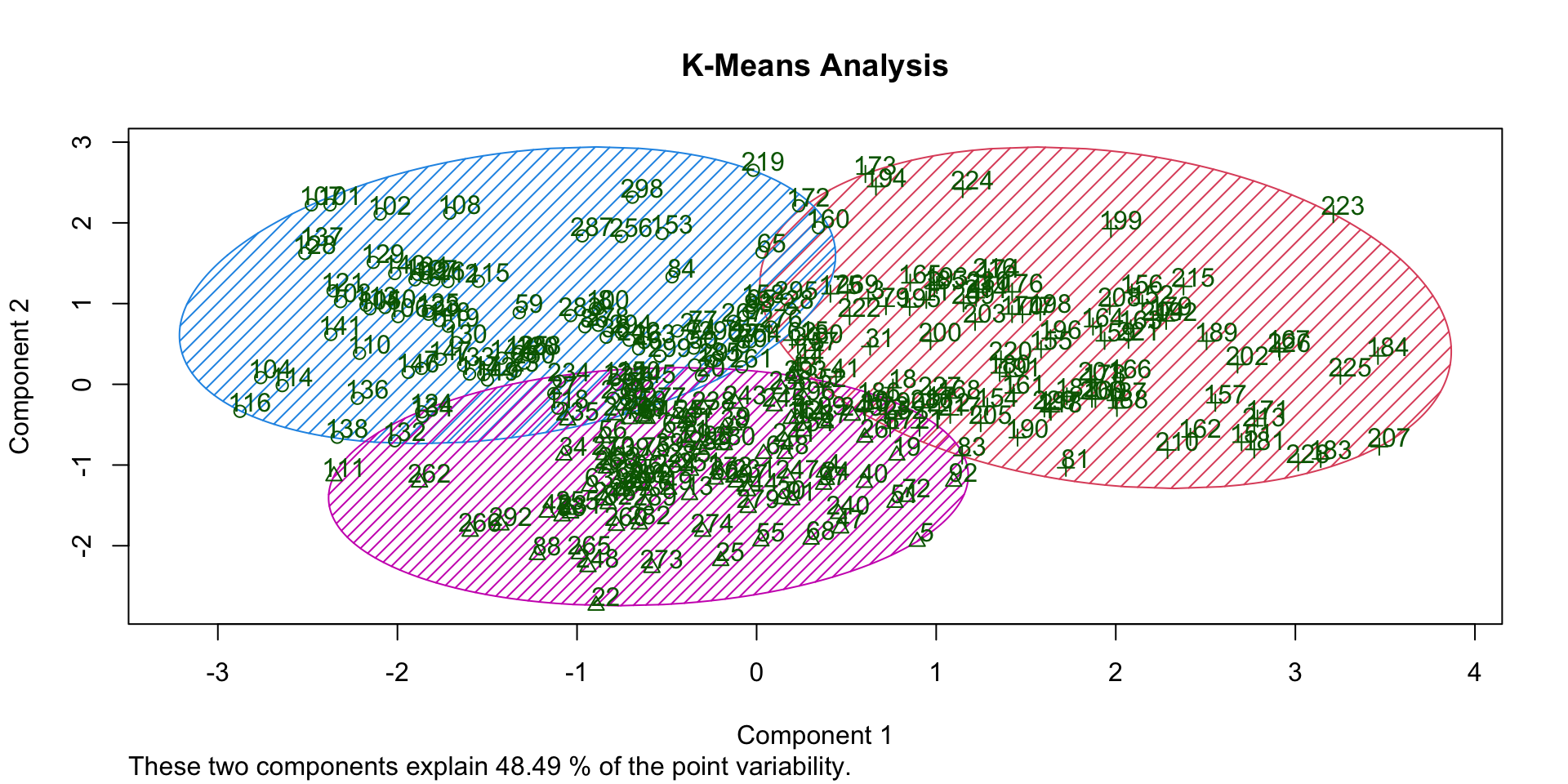
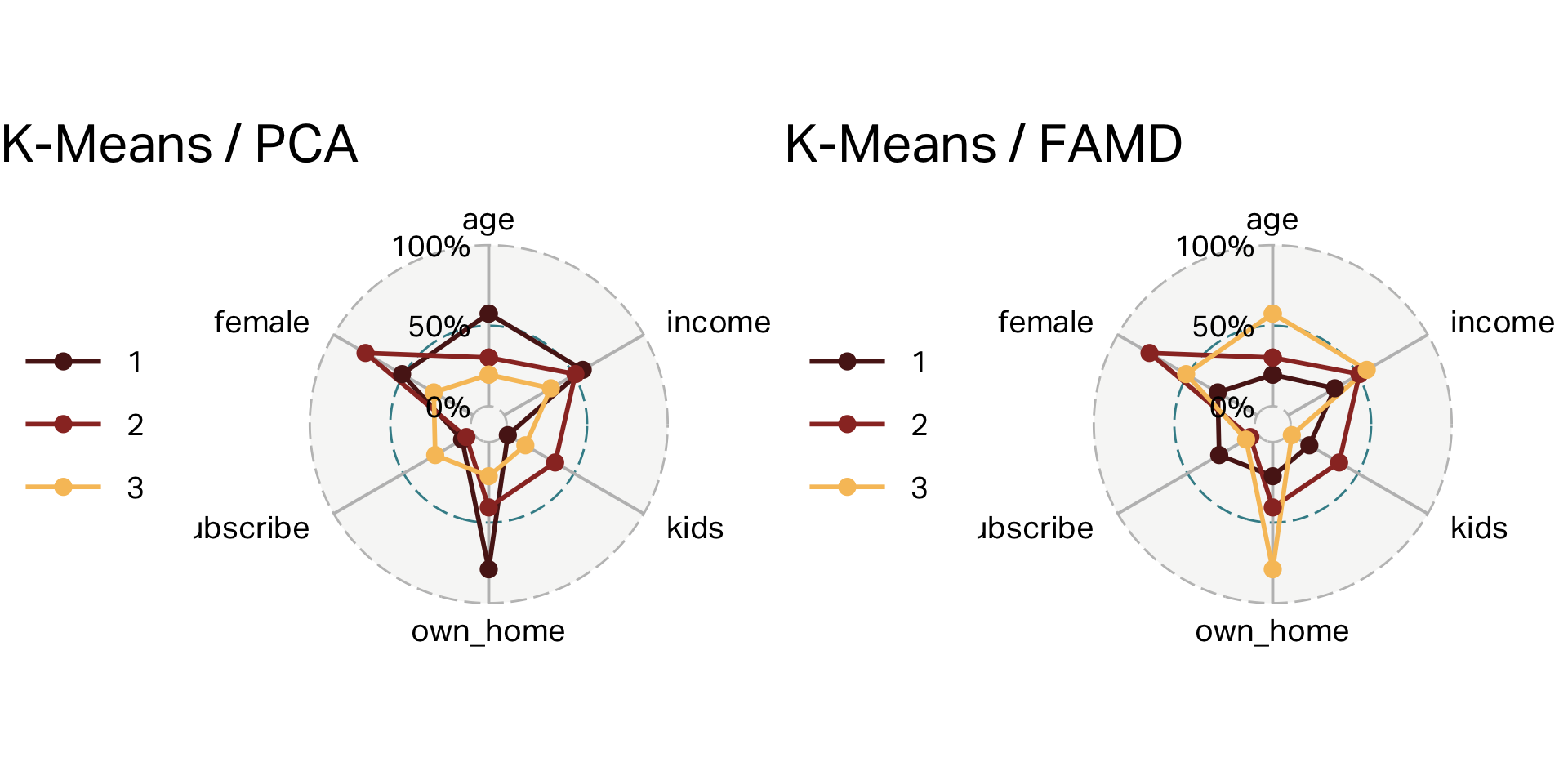
Three clusters (K-means)
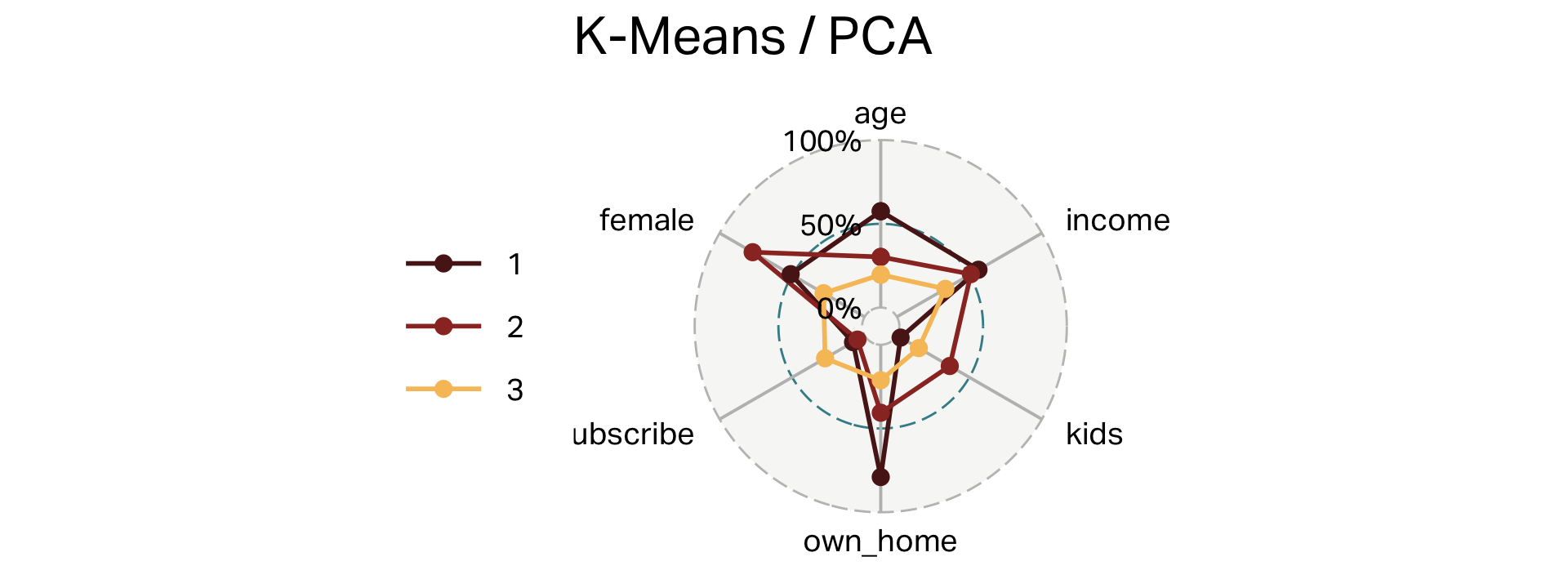
cluster n age income kids own_home subscribe female
1 100 55 60,107 0 79% 8% 51%
2 101 38 56,016 3 41% 5% 77%
3 99 28 28,270 1 21% 27% 28%

Overlap (K-Means)

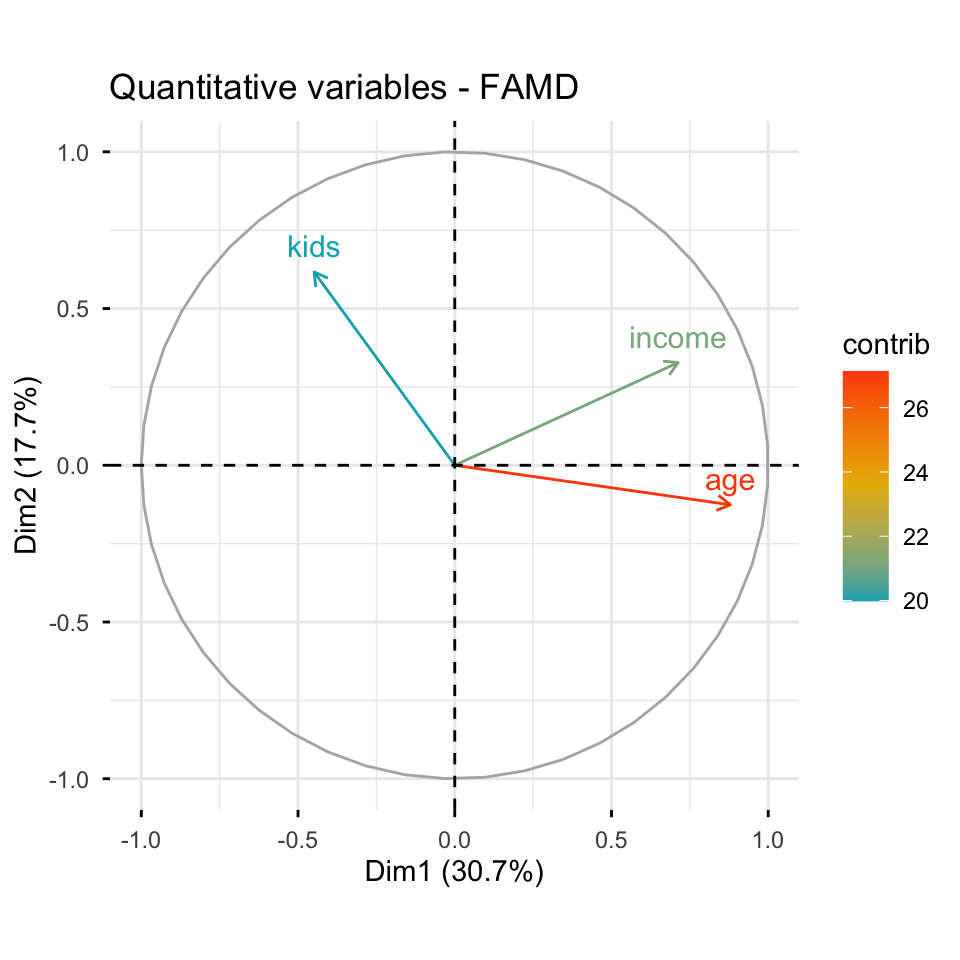
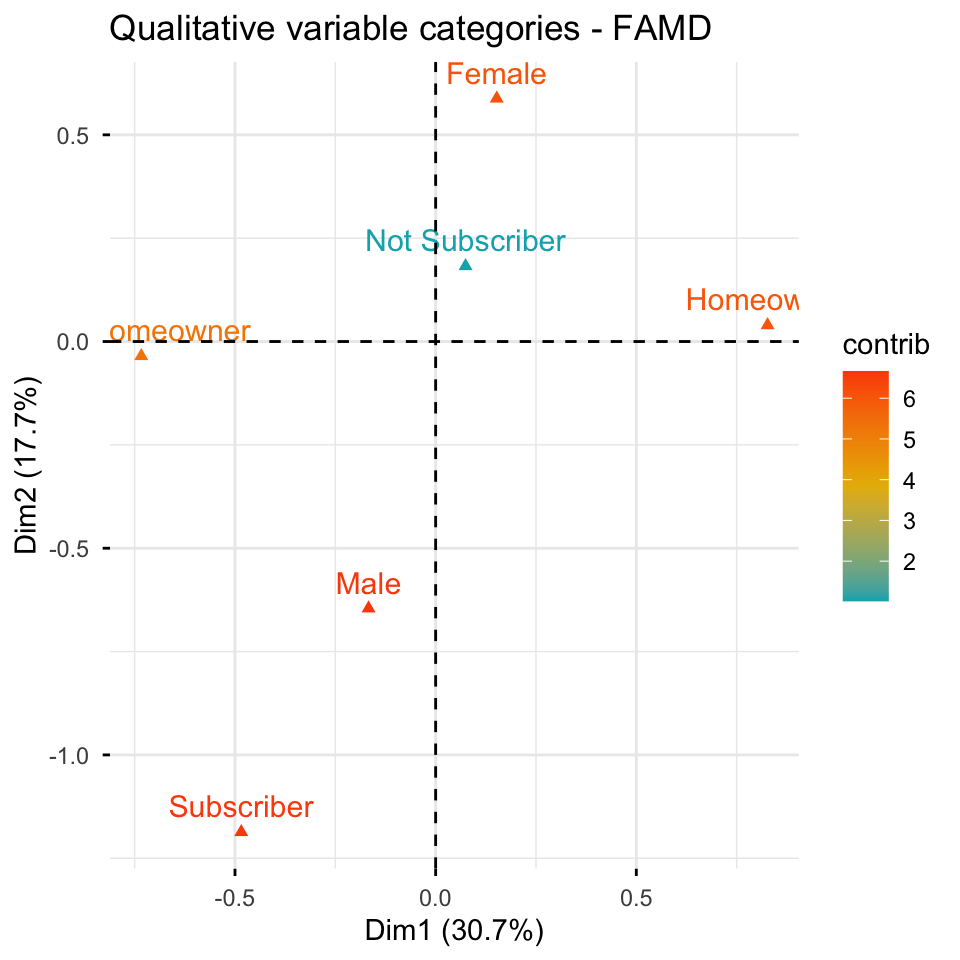
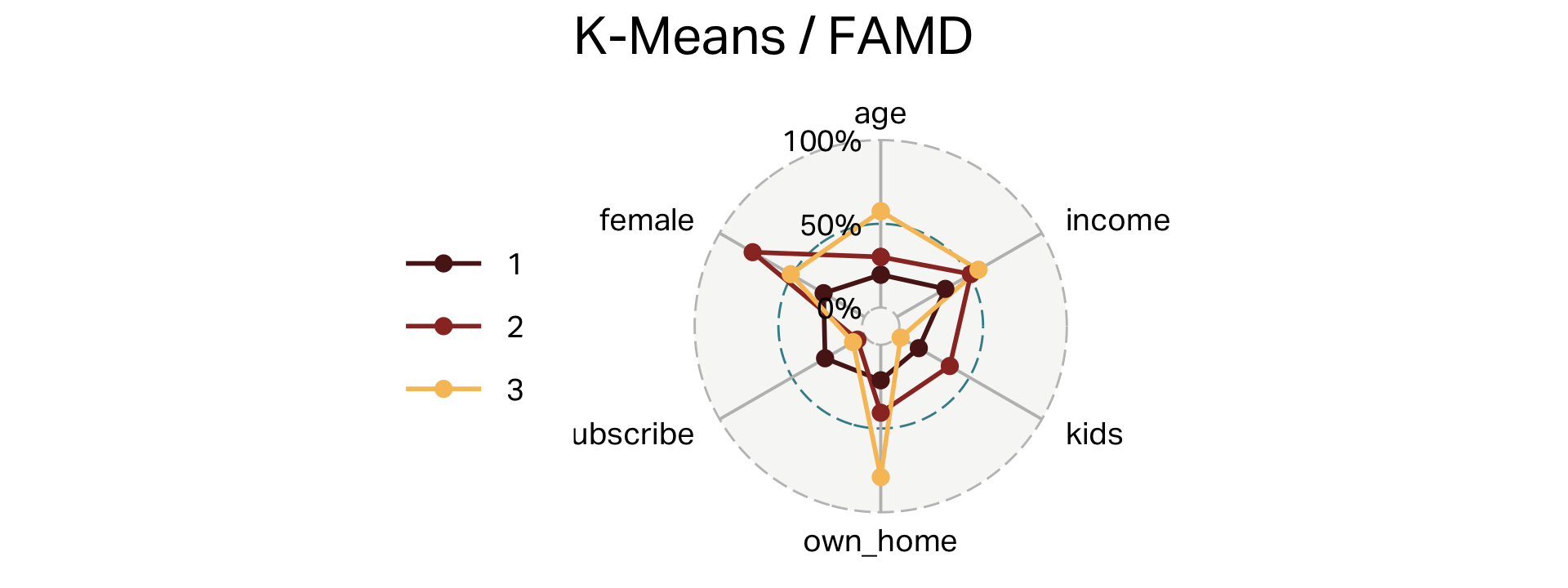
K-Means with FAMD

  • Factor Analysis of Mixed Data (FAMD) is a dimension-reduction technique specifically designed for datasets containing both continuous (numeric) and discrete (categorical) variables.
  • Best suited as an alternative to PCA when dealing with mixed variable types.
  • Differentiated from PCA by handling categorical variables directly, capturing associations between numeric and categorical variables effectively.
  • Results can be visualized similarly to PCA; scaling or standardizing numeric variables remains important; optimal when interpreting relationships across diverse data types.

FAMD

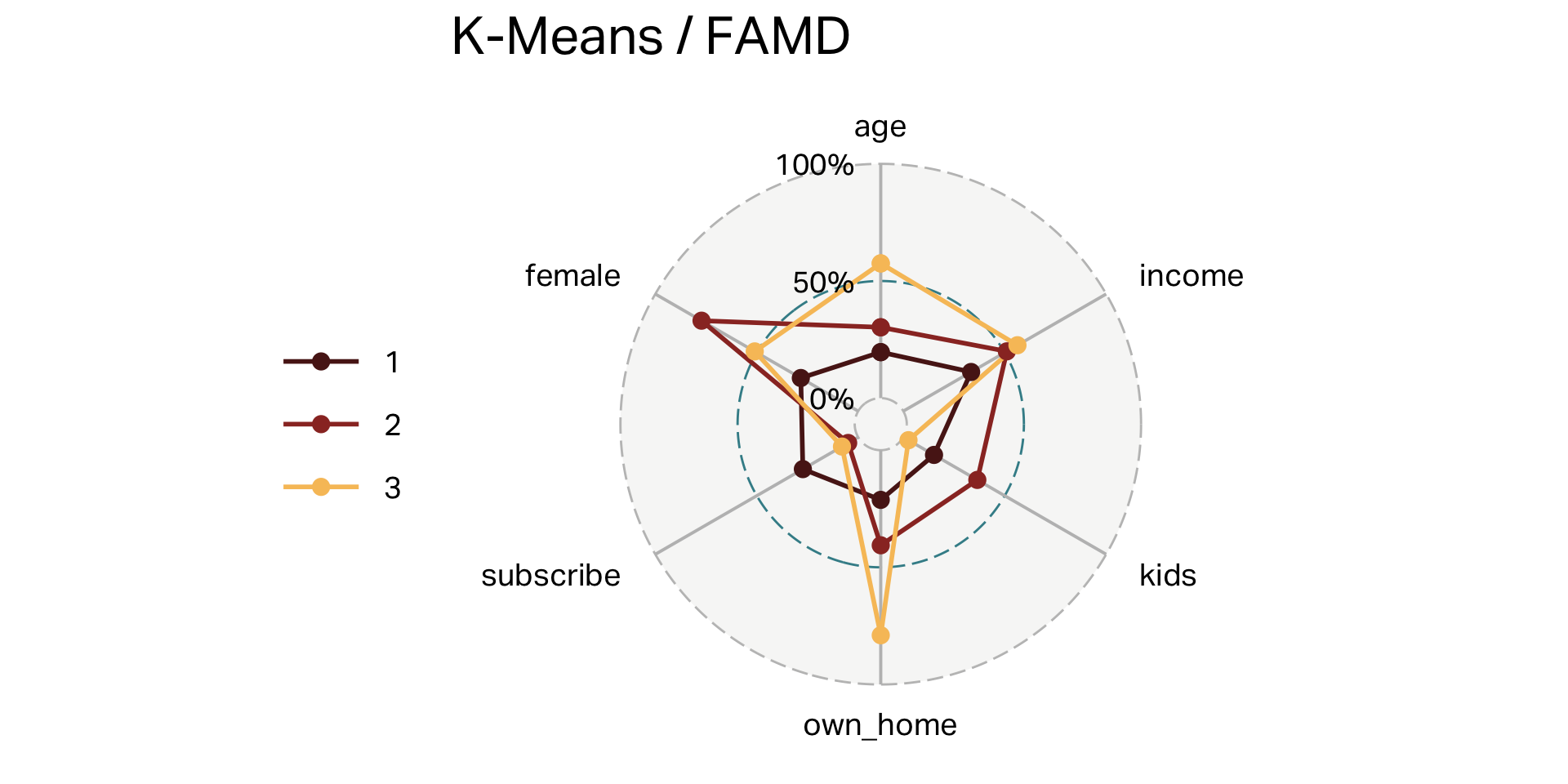
Three clusters (FAMD)

cluster n age income kids own_home subscribe female
1 99 28 28,270 1 21% 27% 28%
2 101 38 56,016 3 41% 5% 77%
3 100 55 60,107 0 79% 8% 51%

Overlap (FAMD)

Comparison

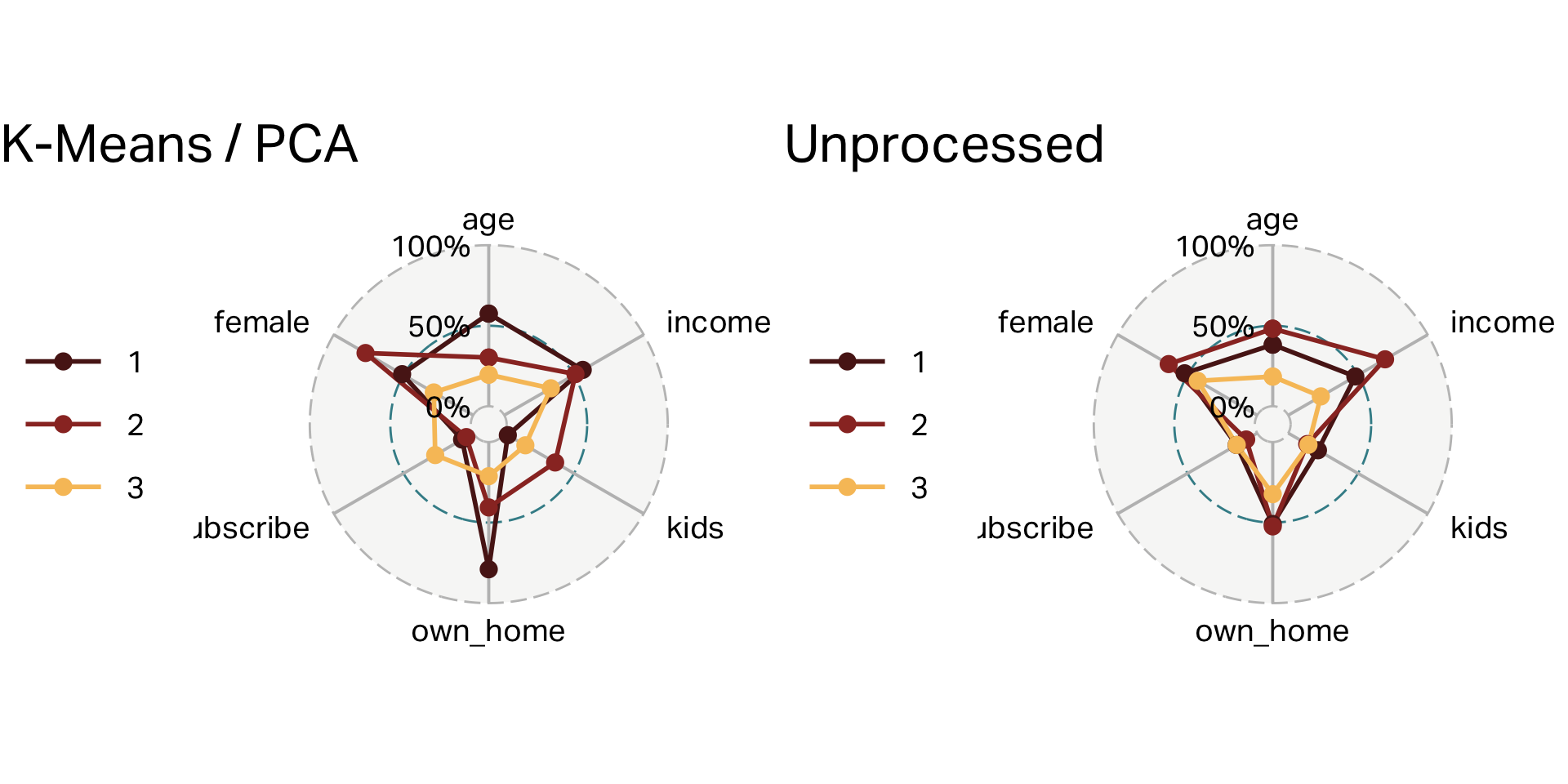
What if we didn’t process at all?

K-Means with no pre-processing

cluster n age income kids own_home subscribe female
1 169 41 52,298 1.00 0.51 0.15 0.52
2 63 48 73,241 0.00 0.52 0.08 0.63
3 68 25 22,979 1.00 0.32 0.15 0.43

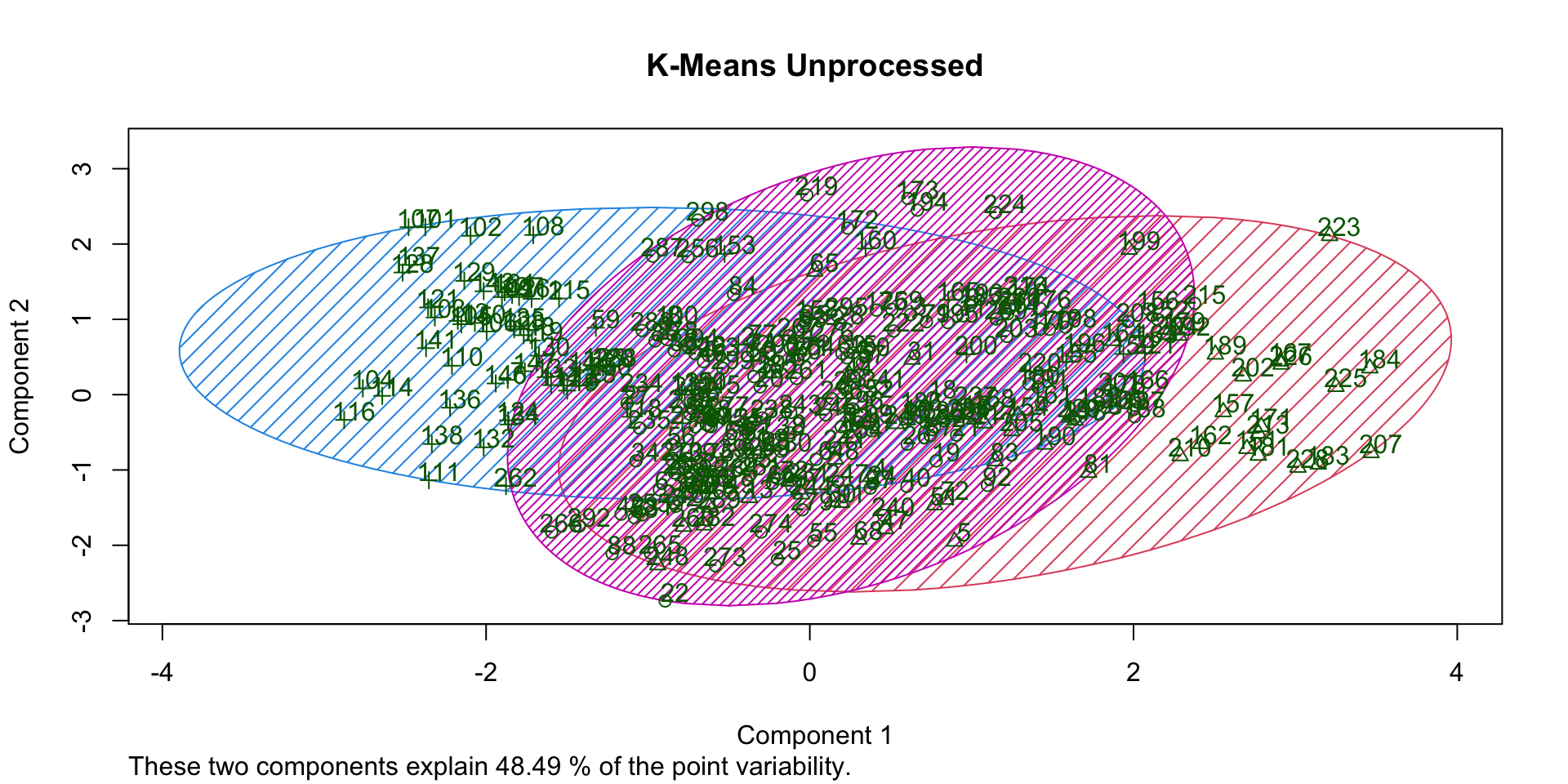
K-Means with no pre-processing

Overlap (no processing)
Hierarchical clustering

Hierarchical clustering

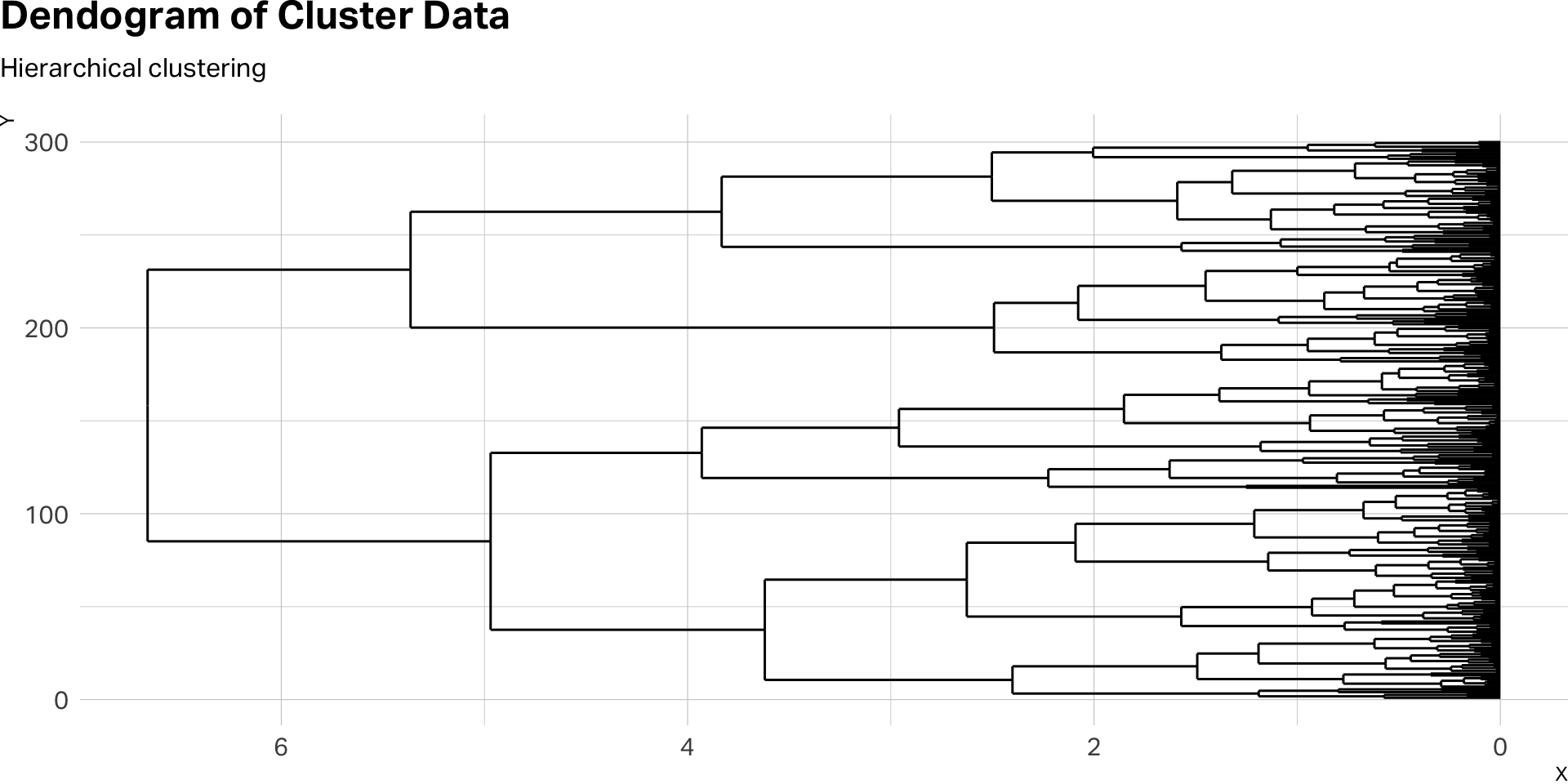
  • Hierarchical clustering is a method that builds nested clusters by iteratively merging or splitting data points based on similarity, resulting in a dendrogram that visualizes cluster relationships.
  • Best suited when the number of clusters is unknown upfront or when visualizing cluster structures at multiple levels of granularity is valuable.
  • Differentiated from other methods (like k-means or PAM) by its hierarchical, tree-like structure, allowing flexible selection of the number of clusters after analysis.
  • Computationally demanding for very large datasets; sensitive to chosen distance metrics and linkage criteria (e.g., single, complete, average linkage).

Dendograms

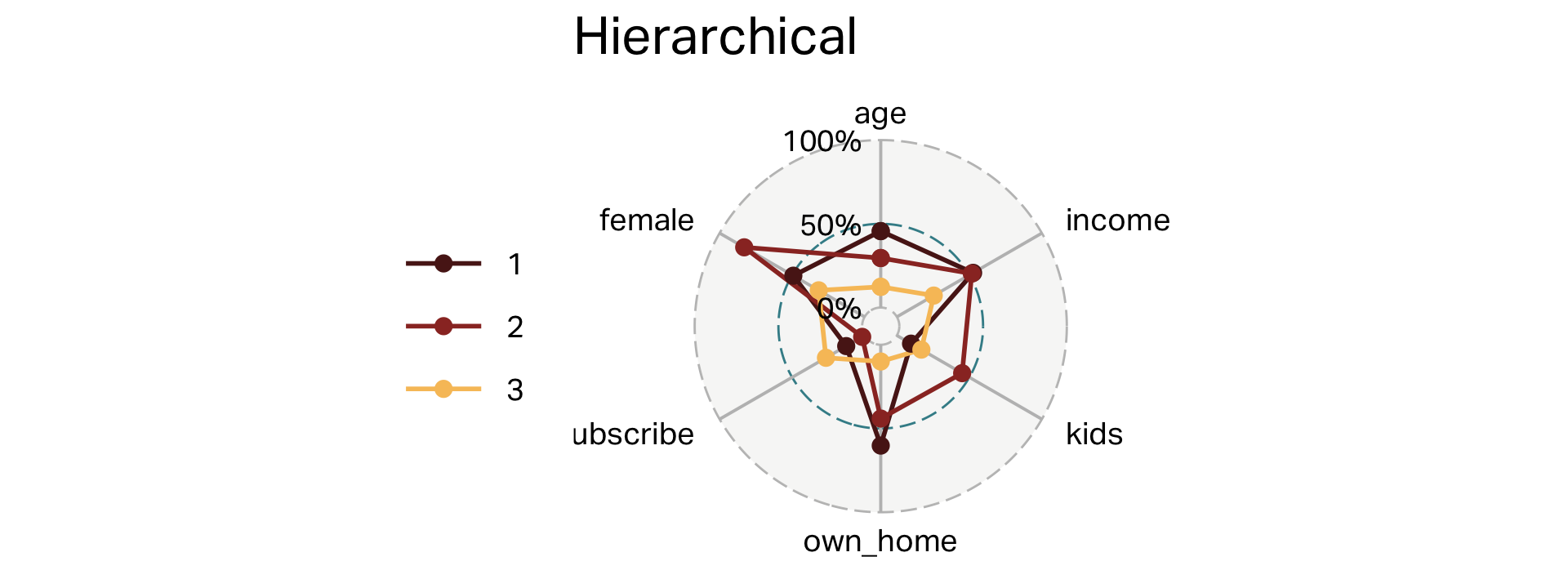
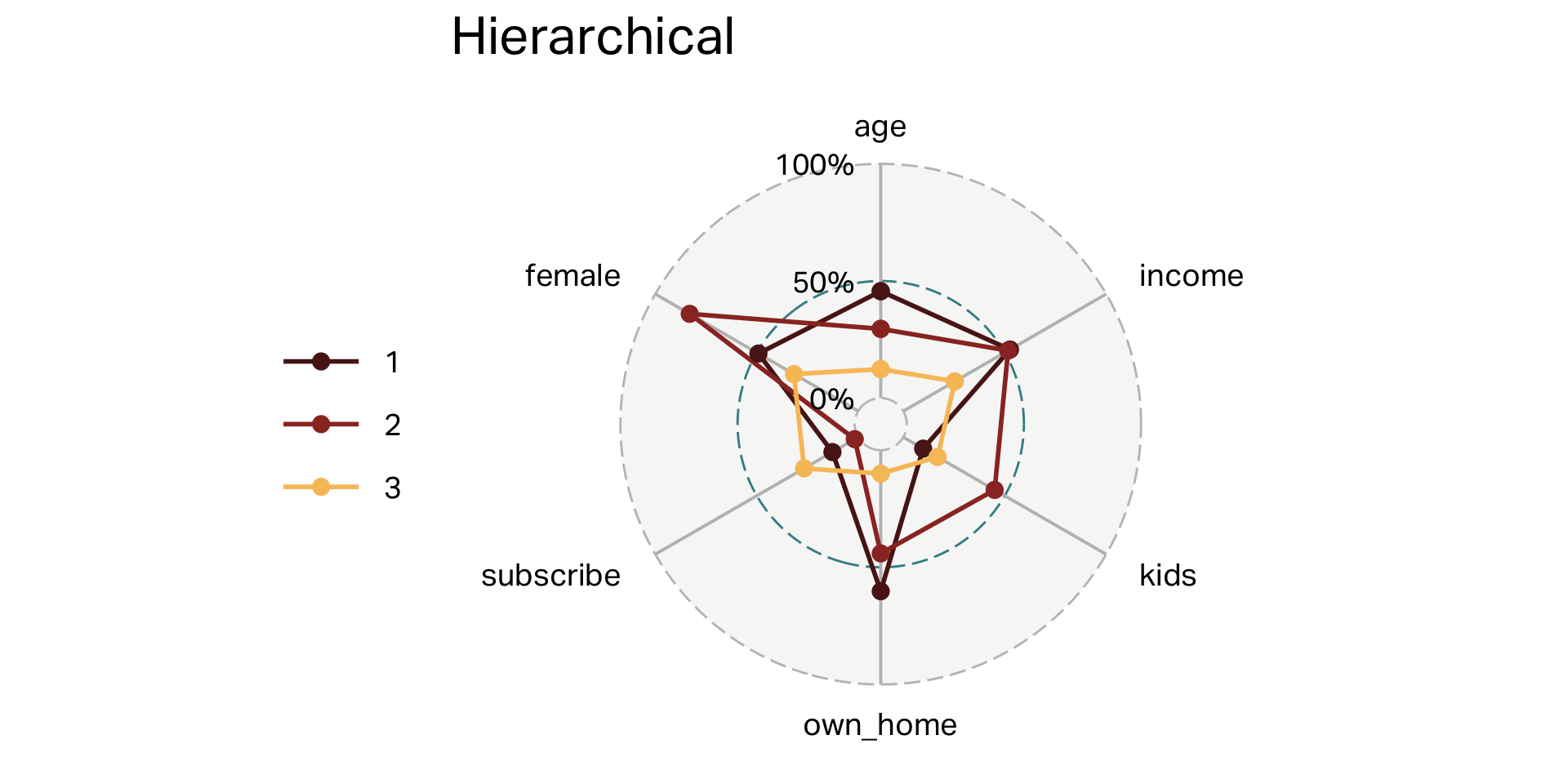
Clusters (HC)

segment n age income kids own_home subscribe female
1 181 45 57,037 0 60% 13% 49%
2 59 38 54,509 3 44% 2% 83%
3 60 25 23,116 1 10% 27% 32%

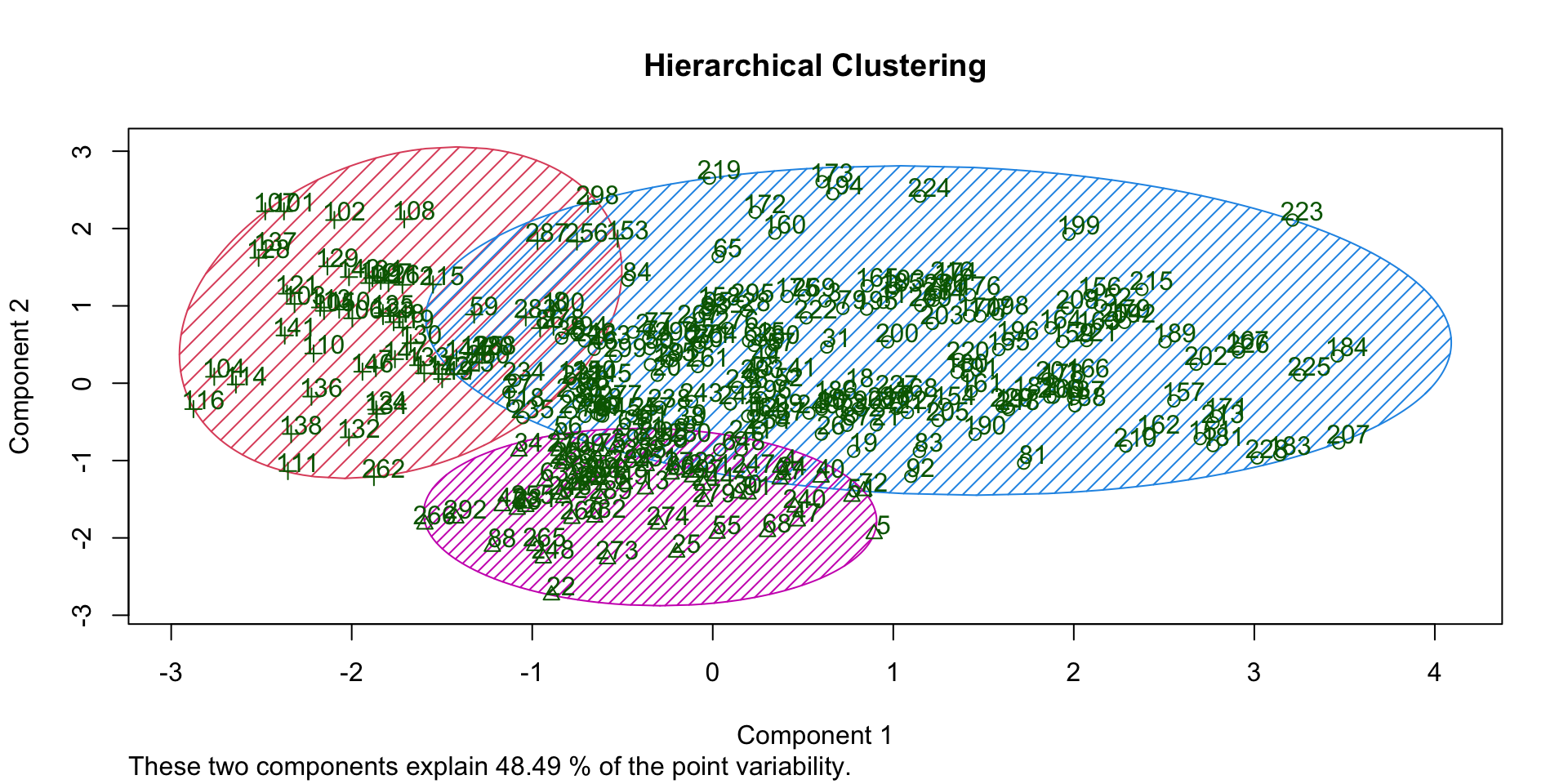
Overlap (HC)

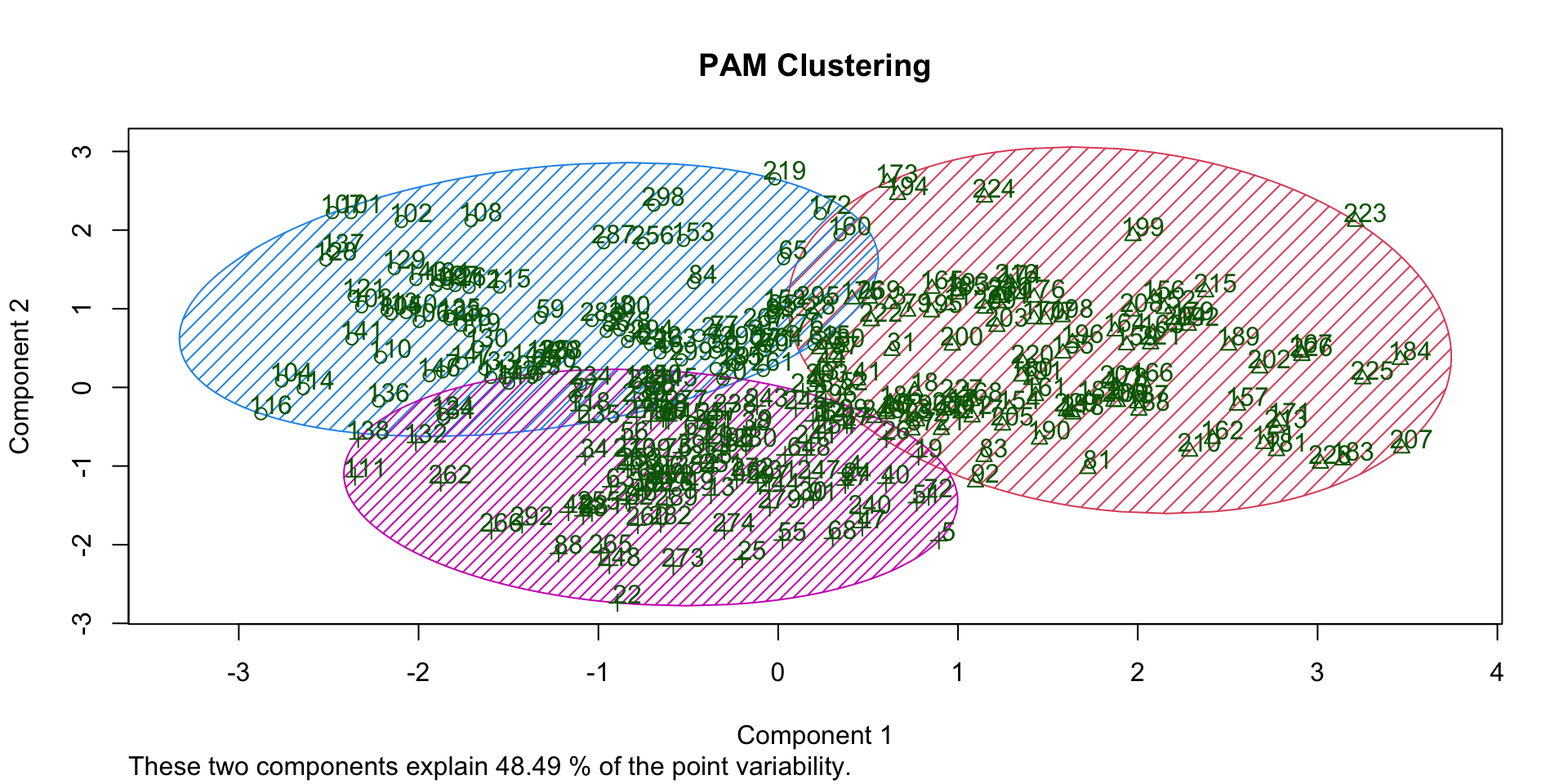
PAM clustering

PAM

  • Partitioning Around Medoids (PAM) is a clustering algorithm that groups data points around representative medoids—actual data points that serve as cluster centers.
  • Best suited for situations with smaller datasets or when data contains outliers, as medoids are robust and less sensitive to extreme values.
  • Differentiated from methods like k-means by using real data points as cluster centers (medoids), rather than computed averages (centroids), enhancing interpretability and stability.
  • Computationally intensive on large datasets; consider using faster variants (e.g., CLARA) for bigger samples.

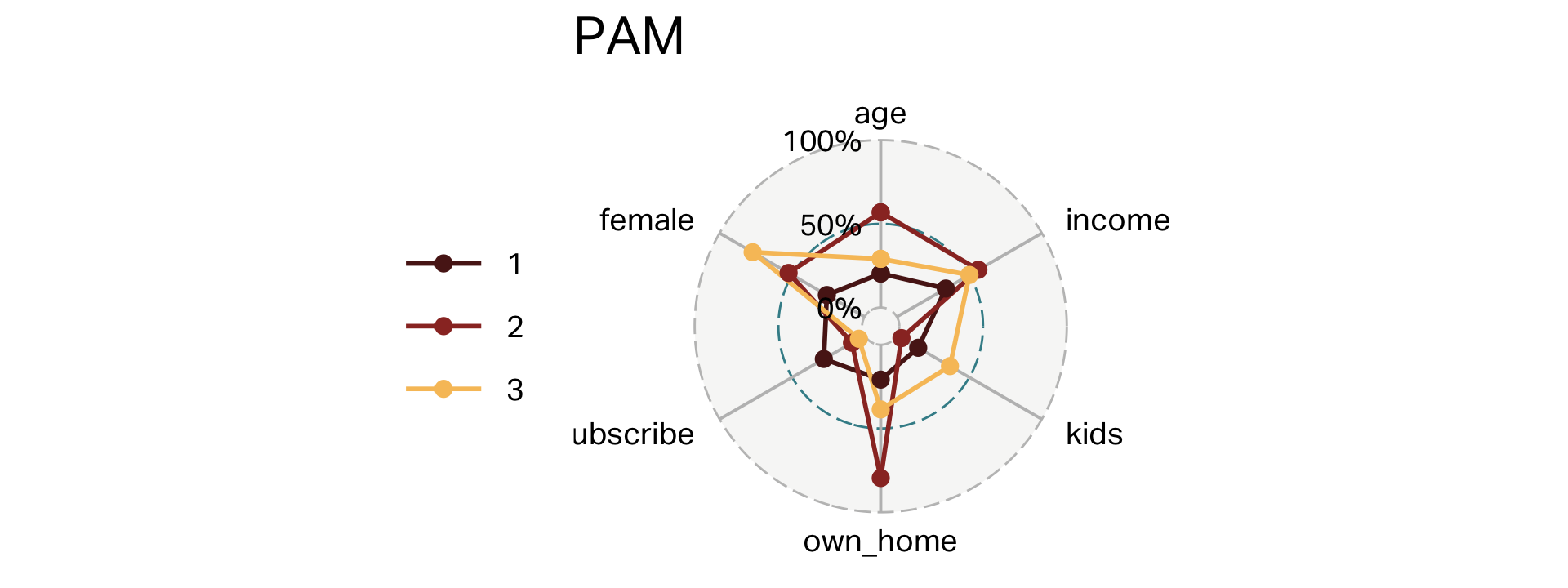
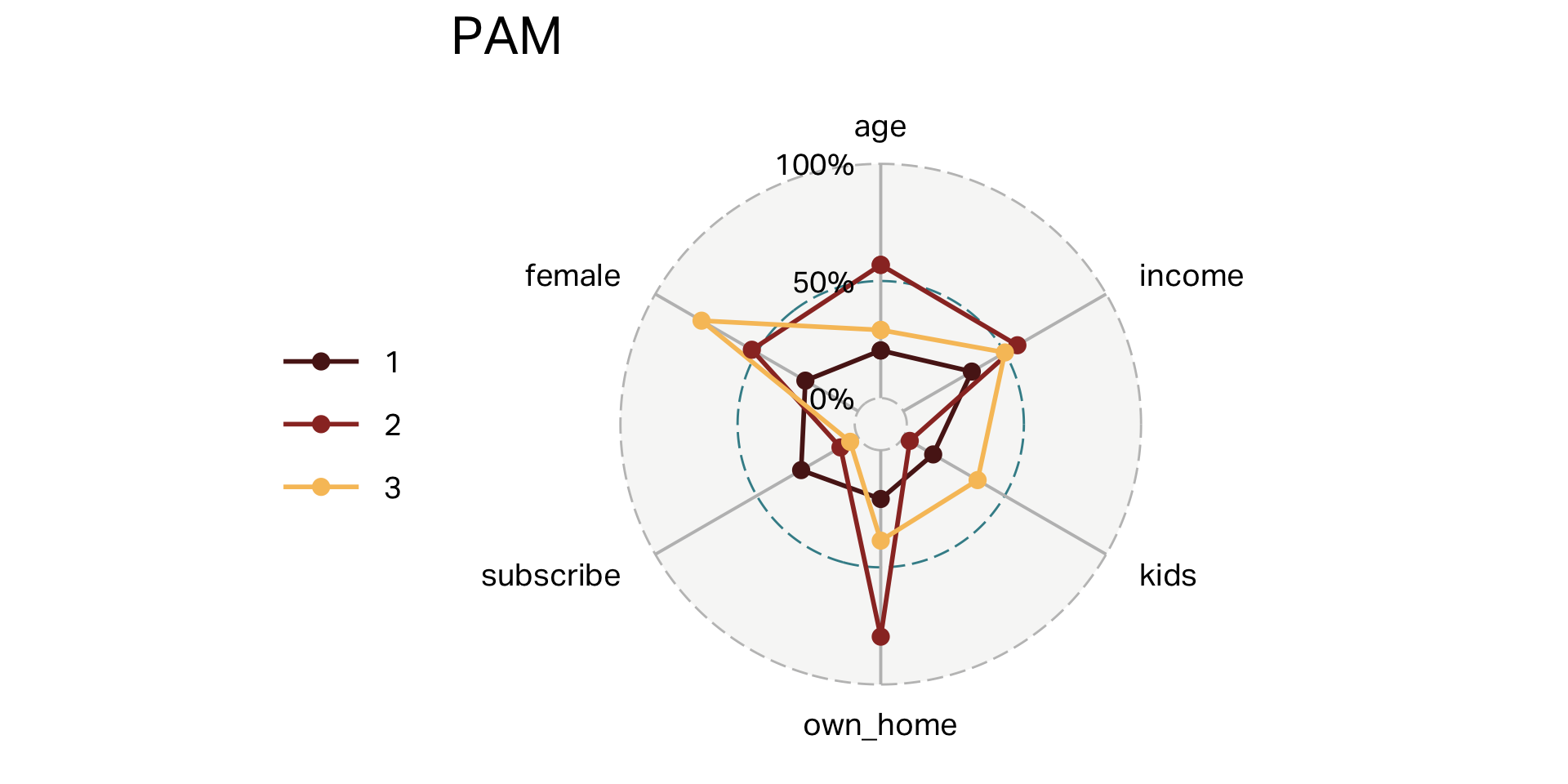
Clusters (PAM)

segment n age income kids own_home subscribe female
1 96 31 28,793 1 21% 28% 26%
2 103 54 60,168 0 80% 9% 52%
3 101 38 55,847 3 39% 4% 77%

Overlap (PAM)

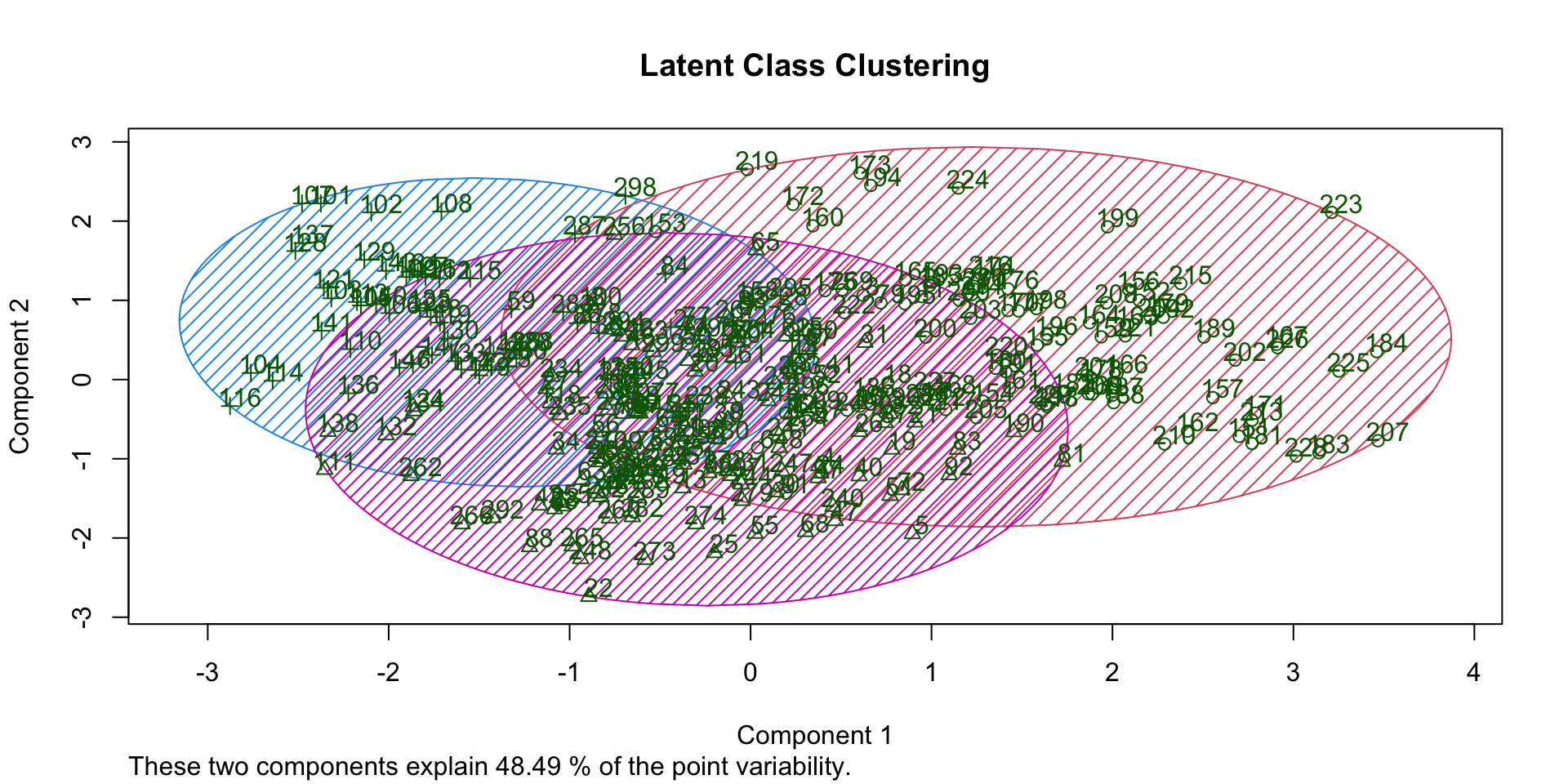
Latent Class Analysis

Latent Class Analysis

  • Latent Class Analysis (LCA) identifies unobserved (“latent”) segments based on patterns in categorical or binary variables, using probabilistic modeling.
  • Best suited for clustering respondents based on survey or categorical data, particularly when dealing with psychological, attitudinal, or preference measures.
  • Differentiated from other methods by modeling underlying segment membership probabilistically, allowing respondents to belong partially (with probabilities) to multiple segments rather than just one.
  • Requires larger sample sizes for reliable segment solutions; selecting the number of segments typically involves comparing model-fit statistics (e.g., AIC, BIC).

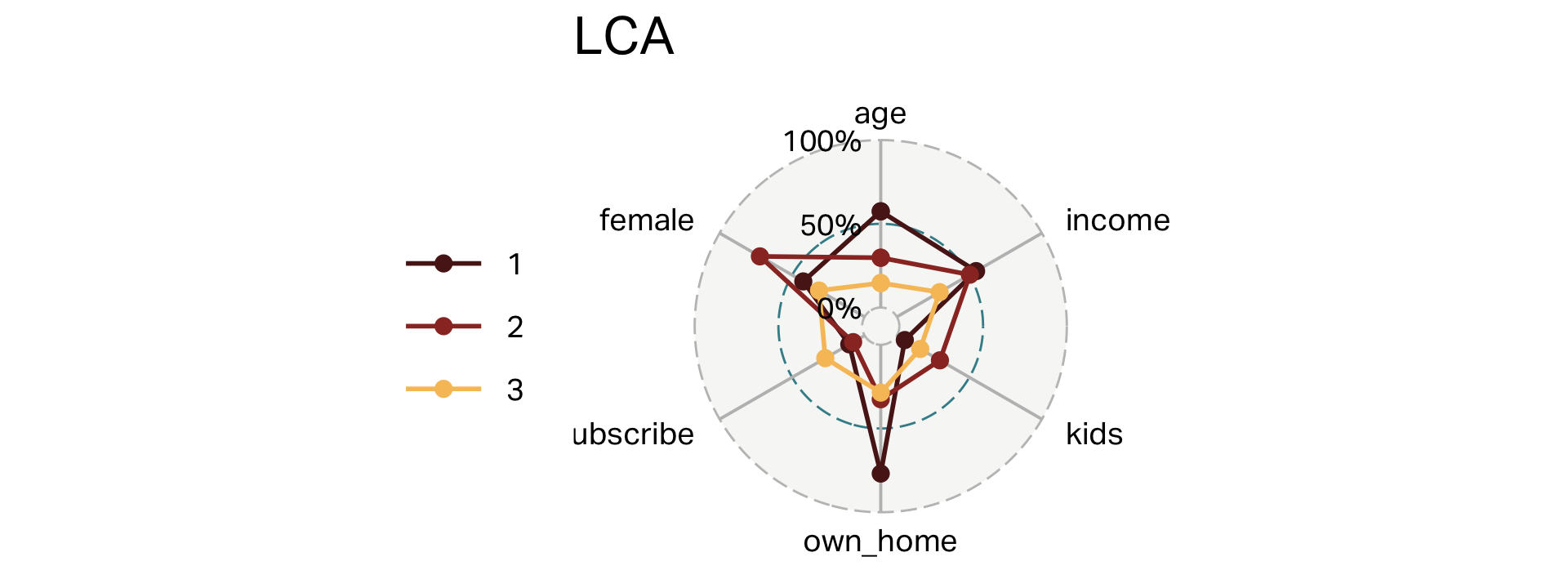
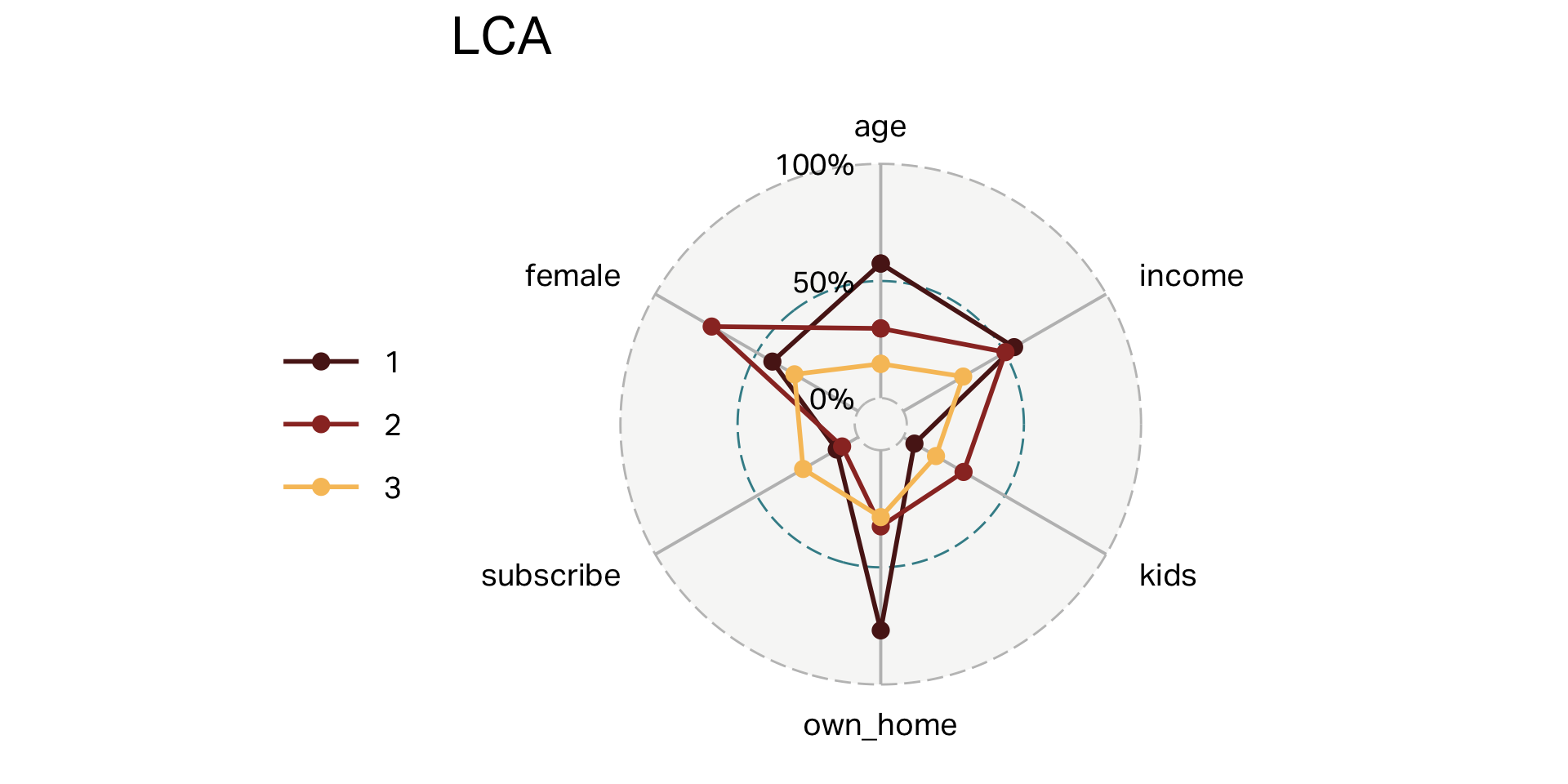
Clusters (LCA)

segment n age income kids own_home subscribe female
1 104 55 58,215 0 77% 11% 42%
2 126 37 55,613 2 33% 8% 72%
3 70 25 24,872 1 29% 27% 31%

Overlap (LCA)

Fine-Tuning

Overlaps could be because of the choices I made in transforming to categorical data. For simplicity, I chose to divide the data at the median line, but it might be better another way.


# Create a copy of our base dataset
lat_clust_data <- df

# Transform each variable into a categorical (or factor) variable
lat_clust_data$age <- factor(ifelse(lat_clust_data$age < median(lat_clust_data$age), 1, 2))


lat_clust_data$income <- factor(ifelse(lat_clust_data$income < median(lat_clust_data$income), 1, 2))
lat_clust_data$kids <- factor(ifelse(lat_clust_data$kids < median(lat_clust_data$kids), 1, 2))
lat_clust_data$own_home <- factor(lat_clust_data$own_home)
lat_clust_data$female <- factor(lat_clust_data$female)
lat_clust_data$subscribe <- factor(lat_clust_data$subscribe)

Clusters

Your turn

  • Huddle up in your groups
  • Discuss how you might want to segment the data you are collecting for KCRW, if at all
  • Which data would you use for the clustering algorithm?
  • Which clustering method would be best? Why?